
Description
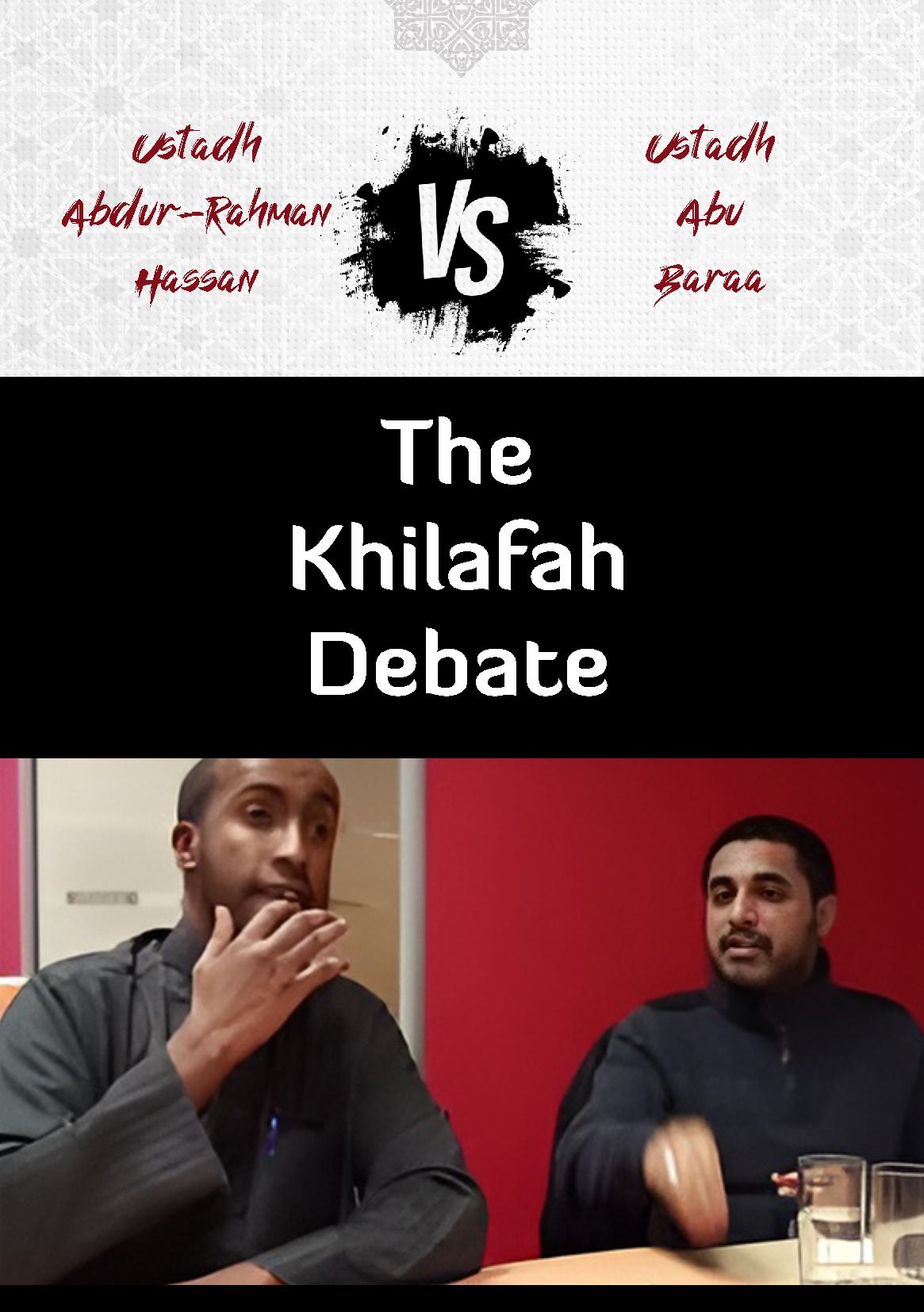
This particular debate was sparked by competing online commentary by Ustadh Abu Baraa, Ustadh Abdur Rahman Hassan, and his student Dawah Man (Imran ibn Mansur), about the recent events in Iraq and Syria in the following the announcement of a caliphate in June 2014. Private discussions between Dawah Man and his critics led to an invitation to a public debate. The invitation was for Ustadh Abu Baraa to debate Dawah Man’s teacher, Ustadh Abdur Rahman Hassan.
On 1st Ramadan 1435 (29 June 2014 CE), a world changing event shook the world. A rebel group in Iraq and Syria known as the Islamic State of Iraq and Sham (ISIS) declared to the world that they had seized territory as a new state actor in the region, renaming themselves Islamic State, and declaring their government a global caliphate.
This sent shockwaves around the world, leading to a global military coalition declaring war on the newly declared country and rejecting its status as a state actor. Intellectual, academic, religious, and political debate ensued all around the world. With some academics such as Cambridge’s Glen Rangwala assessing the state as being comparable to modern nation states despite its lack of United Nation’s acknowledgement, considered its facts requiring revision or redefinition of statehood, arguing that the alleged caliphate was a “de facto state.” (Rangwala 2014) Politically, western nations publicly rejected its named statehood, declaring them illegitimate. Many also criminalised dissenting speech that might undermine the western hegemonic world order that defined states as requiring the permission of the United Nations, while also evading the vetoes of the permanent security council members. Despite this, many western journalists and politicians referred to the new ‘caliphate’ as a state and treated them as such.
In the Muslim world, religious scholars and secular spectators differed widely about what to make of the state. Award (Peabody Awards 2014) winning Al Jazeera Reporter, Medyan Dairieh, publicly declared his belief that they were a caliphate and a legitimate state actor, despite his declining to support or give any allegiance to them, pointing out that the two concepts are not contradictory (mtv 2014). On the other hand, other journalists and spectators strongly condemned and rejected the group/state and their claim to being a caliphate.
In the UK, and wider English-speaking world, Muslims were equally divided with many prominent community leaders signing an open letter in condemnation of the group/state (Shariah Source at Harvard Law School 2014). Naturally, a public debate raged in the months after this declaration, and much confusion ensued about the meaning of Khilāfah, its rules and conditions and what to make of the claims of these organisations around the world.
Many newcomers will not remember the events of 2014 or the discussions that took place publicly or privately about them. New generations of historians, scholars, and academics will speculate about what people in 2014 thought and said about the global acts of state actors, often with influence from reductive, polemic, and Eurocentric bias. In light of the historical trend of eurocentrism in literature and the rewriting of history, it is especially valuable to document ethnic minority voices, speaking from their own perspective and lived experiences.
A true student of history should therefore find this work particularly valuable in the study of statehood in the modern world, and the discussion of Khilāfah, its conditions and place in modern politics in the 21st Century.
Details
Publisher - BookVAULT Publishing
Language - English
Perfect Bound
Contributors
By author
Abu Baraa
Published Date - 2026-08-25
ISBN - 9781808970535
Dimensions - 21 x 14.8 x 1.6 cm
Page Count - 281
Payment & Security
Your payment information is processed securely. We do not store credit card details nor have access to your credit card information.