
Description
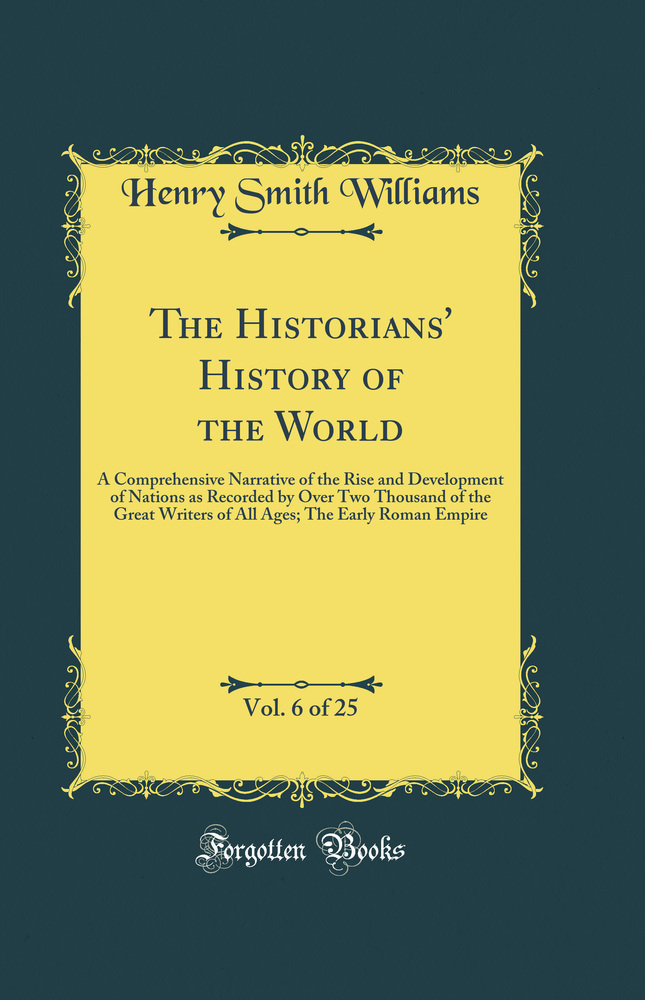
Excerpt from The Historians'' History of the World, Vol. 6 of 25: A Comprehensive Narrative of the Rise and Development of Nations as Recorded by Over Two Thousand of the Great Writers of All Ages; The Early Roman Empire
What is the secret of the vivid interest which the Roman Empire awakens even in the minds of those who feel little drawn towards the study of antiq uity? It is, in the first place, undoubtedly because this period is in many respects more modern in character than any other of ancient times; far more so than the Byzantine Empire or the Middle Ages. It is a period of transition, in which vast revolutions came about in politics and religion and the seed of a new civilisation was sown. Its true significance is not to be found in the creation of a world-wide empire. Republican Rome had already subdued the East in her inexorable advance; Macedonia and Greece, Syria, Asia, Africa, and, finally, Egypt, had fallen into her hands before the setting up of the imperial throne.
In the West, again, Spain and the south of Gaul had long been Roman when Julius Caesar started on the campaign which decided the future of Europe, and pushed the Roman frontier forward from the Rhone to the Rhine. The sway of Rome already extended over all the coasts of the Medi terranean, and the accessions made to her dominions during the period of imperial rule were comparatively insignificant. The Danubian and Alpine provinces were won for the Roman Empire by Augustus, Britain was con quered by Claudius, Dacia and Arabia by Trajan, beside the conquests which his successor immediately relinquished. Germania and the kingdom of Parthia. Permanently withstood the Roman onset, and the construction of the Upper Germanic and Raetian I/lmes by Domitian was an Official recognition of the invincibility of the Germanic barbarians. The counsel of resignation, given by Augustus to his successors out of the fulness of his own bitter experience, warning them to keep the empire within its natural frontiers, i.e., the Rhine, Danube, and Euphrates, was practically followed by them, and Hadrian did unquestionably right in breaking altogether with his predecessor''s policy of expansion and refusing to expose the waning might of the empire to a con tinuous struggle to which it was no longer equal.
About the Publisher
Forgotten Books publishes hundreds of thousands of rare and classic books. Find more at www.forgottenbooks.com
This book is a reproduction of an important historical work. Forgotten Books uses state-of-the-art technology to digitally reconstruct the work, preserving the original format whilst repairing imperfections present in the aged copy. In rare cases, an imperfection in the original, such as a blemish or missing page, may be replicated in our edition. We do, however, repair the vast majority of imperfections successfully; any imperfections that remain are intentionally left to preserve the state of such historical works.
What is the secret of the vivid interest which the Roman Empire awakens even in the minds of those who feel little drawn towards the study of antiq uity? It is, in the first place, undoubtedly because this period is in many respects more modern in character than any other of ancient times; far more so than the Byzantine Empire or the Middle Ages. It is a period of transition, in which vast revolutions came about in politics and religion and the seed of a new civilisation was sown. Its true significance is not to be found in the creation of a world-wide empire. Republican Rome had already subdued the East in her inexorable advance; Macedonia and Greece, Syria, Asia, Africa, and, finally, Egypt, had fallen into her hands before the setting up of the imperial throne.
In the West, again, Spain and the south of Gaul had long been Roman when Julius Caesar started on the campaign which decided the future of Europe, and pushed the Roman frontier forward from the Rhone to the Rhine. The sway of Rome already extended over all the coasts of the Medi terranean, and the accessions made to her dominions during the period of imperial rule were comparatively insignificant. The Danubian and Alpine provinces were won for the Roman Empire by Augustus, Britain was con quered by Claudius, Dacia and Arabia by Trajan, beside the conquests which his successor immediately relinquished. Germania and the kingdom of Parthia. Permanently withstood the Roman onset, and the construction of the Upper Germanic and Raetian I/lmes by Domitian was an Official recognition of the invincibility of the Germanic barbarians. The counsel of resignation, given by Augustus to his successors out of the fulness of his own bitter experience, warning them to keep the empire within its natural frontiers, i.e., the Rhine, Danube, and Euphrates, was practically followed by them, and Hadrian did unquestionably right in breaking altogether with his predecessor''s policy of expansion and refusing to expose the waning might of the empire to a con tinuous struggle to which it was no longer equal.
About the Publisher
Forgotten Books publishes hundreds of thousands of rare and classic books. Find more at www.forgottenbooks.com
This book is a reproduction of an important historical work. Forgotten Books uses state-of-the-art technology to digitally reconstruct the work, preserving the original format whilst repairing imperfections present in the aged copy. In rare cases, an imperfection in the original, such as a blemish or missing page, may be replicated in our edition. We do, however, repair the vast majority of imperfections successfully; any imperfections that remain are intentionally left to preserve the state of such historical works.
Details
Publisher - Forgotten Books
Language - English
Hardback
Contributors
Author
Henry Smith Williams
Published Date -
ISBN - 9780265954119
Dimensions - 22.9 x 15.2 x 3.8 cm
Page Count - 709
Paperback
Contributors
Author
Henry Smith Williams
Published Date -
ISBN - 9781333059811
Dimensions - 22.9 x 15.2 x 3.8 cm
Page Count - 711
Payment & Security
Your payment information is processed securely. We do not store credit card details nor have access to your credit card information.